The following post was kindly written and shared by Foster Hill Road Cemetery, Bedford
This story is based on a report which appeared in the Bedfordshire Mercury on 22nd July 1837.
On a Tuesday morning, 18th July 1837, Bedford found itself unusually animated. Long before the appointed hour, people began gathering in Mill Street, drawn by a sense that something new—almost historic—was about to take place. For the first time in the town, a marriage was to be solemnised in a Dissenting chapel under the provisions of the new Marriage Act, and curiosity alone would have ensured a crowd.
In the event, more than three hundred people attended. The Old Meeting House, under the pastoral care of the Rev. Samuel Hillyard, had been duly licensed for marriages. This in itself marked a change in the long-
established order, and many present understood that they were witnessing not merely a wedding, but the beginning of a new freedom for Nonconformists in Bedford.
Despite the size of the gathering, the atmosphere was orderly and respectful. There was a brief moment of levity at the start from one individual, but it was immediately checked, and the proceedings were conducted thereafter with decorum.
The bride was Sarah Sletcher and the groom was Thomas Peer. At a quarter past eight in the morning, the Rev. Mr. Hillyard entered the chapel, accompanied by the superintending registrar of the Bedford Union, John Mackenzie, M.A. Before the ceremony began, Mr. Hillyard addressed the congregation. He said that, on this first occasion of a marriage being solemnised there, it was fitting to begin with prayer, which he then briefly offered.
Afterwards, he explained the requirements of the Marriage Act: that the place of worship must be licensed, that it must be a separate building, certified and used as a place of worship for at least a year; that a certificate signed by twenty or more householders must be delivered to the Superintendent Registrar; and that a registrar of marriages must be appointed. He also spoke of the care that must be taken that all legal requirements were met before proceeding.
He then turned to the wider meaning of what was being done. Besides the
Established Church of England, he said, some bodies – such as the Quakers – had long had the privilege of marrying in their own way. Dissenters had not previously joined them in this, but objections to parts of the Church of England ceremony had led them to petition Parliament, and now they had obtained the liberty to perform these services themselves. This, he said, they regarded not merely as a religious privilege, but as raising them in the ranks of society from the depression under which they had laboured.
He expressed satisfaction that the King’s Ministry and the majority of both Houses of Parliament had supported this change, and said that Dissenters would show themselves good subjects by conducting such ceremonies in decency and good order.
He then read the first thirteen verses of the third chapter of 1 Peter, and spoke of marriage as an institution appointed by God from the beginning, honoured by Jesus at Cana in Galilee where his first miracle took place at a wedding. He said that marriage was enforced throughout the Scriptures as a solemn duty between husband and wife.
Turning to the couple, he charged them, separately and together, to declare if there were any lawful hindrance to their union. Thomas Peer declared that he knew of none why he might not be joined in matrimony to Sarah Sletcher, and she made the same declaration.
Then, after the minister, Thomas Peer said, in the hearing of all present, that he took Sarah Sletcher to be his lawful wedded wife. She repeated the same words in return. They were then told to take each other by the hand. Whether they used a ring or not, Mr. Hillyard explained, was left their own choice under the Act of Parliament. If they did use one, it was to be regarded as a pledge of their affection. Thomas Peer placed a ring on Sarah’s finger.
With the legal ceremony complete, Mr. Hillyard addressed them again. They had, he said, entered into a connection of the most solemn and important nature, binding themselves to one another for life. They were to share each other’s affections, to
comfort and support one another in health and in affliction, and to remember the engagements they had made before God and in the presence of the congregation.
He spoke of the trials that must be expected in life, whether single or married, and of the duty of husband and wife to minister to each other’s comfort. He exhorted them to continue in the worship of God, and concluded with a prayer, especially calling down a blessing on the Queen and her Ministers.
The whole ceremony lasted thirty-five minutes. When the people left the Old Meeting-house that morning, many must have felt that they had witnessed something more than the joining of Thomas Peer and Sarah Sletcher: they had seen the first visible sign in Bedford of a new chapter in the
religious and civil life of the town.
Thomas and Sarah lived in Bedford for the rest of their lives. They had a large family, though sadly, as was often the case in Victorian times, some of their children died young. Thomas was a carpenter and joiner in his early days, and a butcher by 1861. He then became the collector of the Queen’s taxes for St Paul’s parish, a post he held for 25 years. He was also member of the Bedford Burial Board.
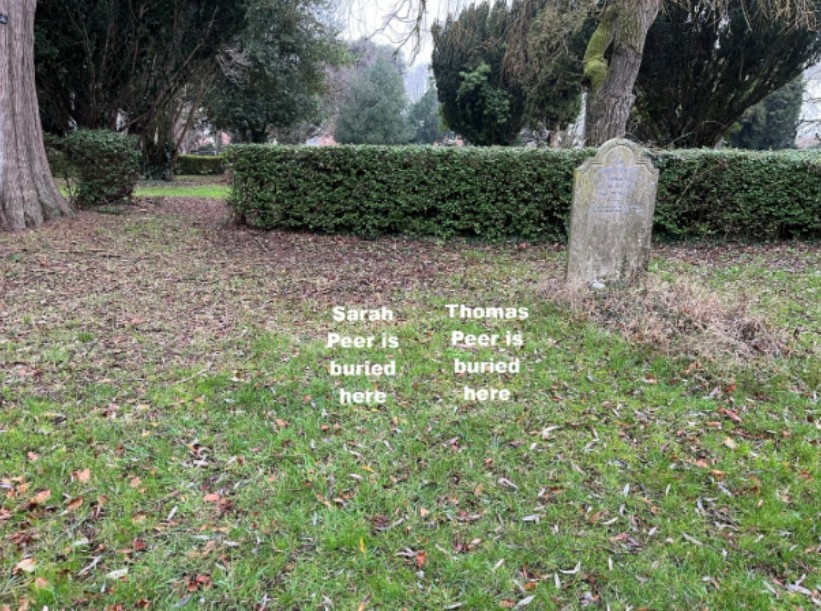
He died in Bedford on 4th January 1889 at the age of 73. Sarah outlived him by just five years, and died in Bedford on 8th January 1894 at the age of 78. They are buried side by side, near a number of other members of their family in unmarked graves in section E8 of Foster Hill Road Cemetery, Bedford.