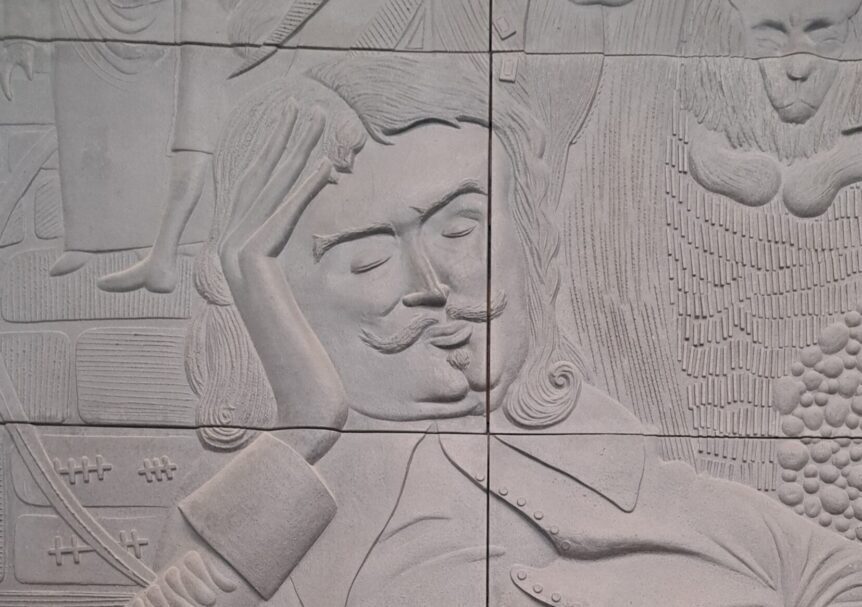
John Bunyan’s life story is rooted in the landscape of Bedford and Bedfordshire. Not only that, his most famous book, The Pilgrim’s Progress takes his lively imagination into the buildings and fields he knew so well.
So our town and countryside are full of Bunyan trails. You can visit his birthplace, and the site of the gaol where he was imprisoned for a third of his adult life. The room where he stood trial is still in existence, and the orchard he and his congregation bought when persecution eased, is still a place of worship, and the site of the John Bunyan Museum.
After reading The Pilgrim’s Progress (in English, or in one of its 300+ translations), you can visit the place after which Vanity Fair, or the brilliantly named ‘Slough of Despond’ (we’ve all been there!) were named. Other trails take the modern day Pilgrim further afield, into the surrounding villages, or to London.
The book, of course, went all over the world, so there are resonances of Bunyan to explore, practically wherever you are. At the John Bunyan Museum, we receive a steady stream of booked tours, including coach tours, from The Netherlands, South Korea, and many more.

And there are monuments. John Bunyan’s statue, erected in 1874, stands on
Bedford’s High Street. Bunyan Meeting Church, still on that orchard site, boasts magnificent bronze doors, 150 years old this year!
There are stained glass windows in Westminster Abbey and Southwark Cathedral, but also, rather wonderfully, in Hinckley URC and Hathersage Parish Church. The most magnificent are to be found as the frontage to Elstow Bunyan Free Church, just outside Bedford. And there is a wonderful set of windows in Bunyan Meeting itself.
As soon as Bunyan 400 started to gather pace, people began to email photos of windows and other memorials and artefacts. And wherever I went, people would point out the Bunyan references in the roads and landscape.
So, on January 7th, we gathered a group representing Bunyan 400, plus
representatives of Bedford Heritage groups, including the Town Guides, local Friends organisations, and our own and other Museums. The meeting was full of enthusiasm, and we have great plans to explore and revive the cultural heritage of John Bunyan.
If you know of a Bunyan reference in your own location, or a monument to the man or his writings, please get in touch. And keep watching the new pages, as they appear on the website. We will be bringing you stories steeped in history, and rooted in landscape.